Enlarged Prostate (BPH) · Short answers
Do BPH procedures require general anesthesia?
Not always. Prostate artery embolization is done with light sedation, or none at all.
The short answer
Not always. Prostate artery embolization is done with light sedation, or none at all.
A closer look
UroLift, a short procedure, is done in our surgery centers with sedation or anesthesia. Aquablation, HoLEP, ThuLEP, and robotic surgery are done with general anesthesia.
Your health and the procedure determine which anesthesia suits you, and all anesthesia carries some risk.
What you can do next
If anesthesia is a worry for you, bring it up at your visit so our urologists can match the option to you.
How we talk about this in Johns Creek and Cumming
Patients who bring this question to 10730 Medlock Bridge Road or to our Cumming office on Deputy Bill Cantrell Memorial Road can walk through it with the urologist they see. The article is background; the visit is where we make a recommendation.
A related official video
An official Advanced Urology video on this topic.
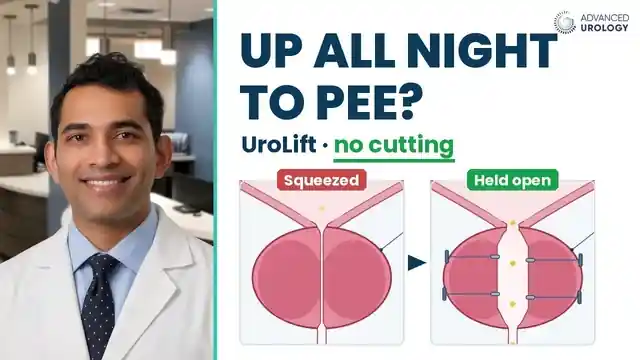 Watch: UroLift in 60 Seconds: Opening an Enlarged Prostate Without Cutting
What the video covers. Titled "UroLift in 60 Seconds: Opening an Enlarged Prostate Without Cutting." The official short video, with Dr. Dev Mally, presents UroLift for an enlarged prostate (BPH) that is narrowing the urethra, as the public description states, without describing tissue removal.
Where to read more
- Our page on this topic
- Johns Creek Clinic & Surgery Center
- Cumming Clinic
- Read this topic on learn.advancedurology.com
- Related page on advancedurology.com
Related articles
- Prostatic Artery Embolization — who is a candidate for PAE?
- Why do I feel like I still have to pee after I pee?
- Why is my urine stream so weak?
- Can BPH cause erectile dysfunction or sexual changes?
- Finasteride vs dutasteride — what is the difference?
Do BPH procedures require general anesthesia?
Not always. Prostate artery embolization is done with light sedation, or none at all.
Can I discuss this at either office?
Yes. We see patients at the Johns Creek Clinic & Surgery Center and at the Cumming Clinic. Mention enlarged prostate (bph) when you book, and we will place the visit.
Request an appointment at Advanced Urology. Call 678-344-8900 or Book online.
Whenever a visit would help, the Johns Creek and Cumming teams are a phone call or a booked appointment away.