Kidney stones
Kidney stone treatment, laid out clearly, in one building
Stones form when the balance of minerals and water in urine shifts and salts crystallize together. Some pass on their own; some need a procedure. Either way, finding out why you form them is part of the visit.
Symptoms worth a call
The classic stone is felt in the flank, below the ribs and above the hip, and it can travel toward the groin in surges rather than staying steady. Urine may look pink, red, brown or cloudy, or smell unusual. Many people feel sick to their stomach or vomit, and some need to urinate urgently and often. Others have a stone with no pain at all.
02The first appointment, step by step
Scans and lab tests are available in both the Johns Creek and Cumming offices, so the first visit usually ends with an answer rather than another referral. If the stone can be managed while it passes, that is the plan. If it needs a procedure, it is scheduled at the Johns Creek surgery center.
03Shock wave lithotripsy (ESWL)
Our urologists treat kidney stones that are a fit for shock wave lithotripsy, also called ESWL, by aiming focused sound energy from outside the body to fracture the stone, so the pieces can pass in the days or weeks after. There is no scope and no incision. Compare this with the other options.
04Laser lithotripsy
During ureteroscopy, a laser breaks the stone so the pieces can be removed. This is the laser lithotripsy step of that procedure, and it is done at our Johns Creek surgery center.
05Ureteroscopy
A thin scope travels up through the bladder to reach the stone. No skin incision is made, and a short-term stent is often left afterward. For very large stones, PCNL, a small opening in the back, is the option reserved for those cases.
06Preventing the next one
Our urologists look for the cause of stone formation. Too little fluid, a diet heavy in protein or sodium, low citrate, metabolic syndrome, obesity, diabetes, gout, parathyroid disorders, and bowel surgery or chronic bowel disease. Blood work and a 24-hour urine collection help our urologists build a prevention plan.
Official stone videos from two urologists who practice in these offices
Dr. T. Casey McCullough, who directs the Johns Creek surgery center, and Dr. Rut Patel, who practices at the Cumming Clinic, are featured in official practice videos about kidney stones, alongside a ureteroscopy explainer. They are a way to get oriented first; the scan and the exam still decide the plan.
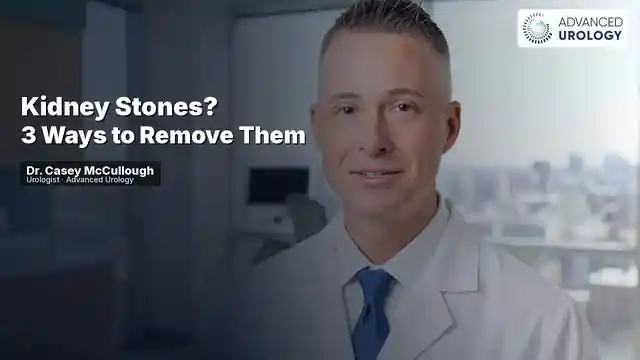 Watch: Kidney Stones? 3 Ways to Remove Them
What the video covers. Titled "Kidney Stones? 3 Ways to Remove Them." The official video, featuring Dr. Casey McCullough, addresses treatment choices for a kidney stone that will not pass, with the public description pointing to size, location, hardness, and overall health as the decision factors.
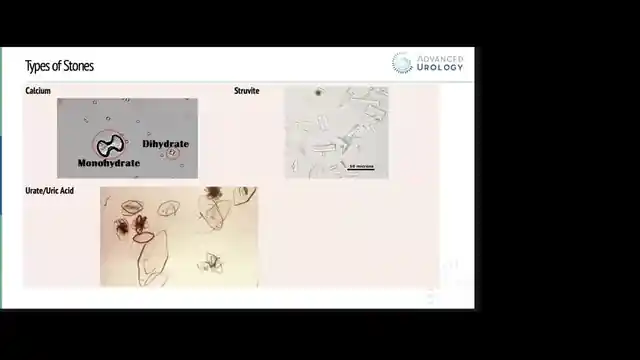 Watch: Kidney Stones Disease with Dr. Rut Patel
What the video covers. This official Advanced Urology video is titled "Kidney Stones Disease with Dr. Rut Patel." Dr. Rut Patel discusses kidney stone disease.
 Watch: Kidney Stones and Ureteroscopy - Everything you need to know
What the video covers. This official Advanced Urology video is titled "Kidney Stones and Ureteroscopy - Everything you need to know." The video addresses kidney stones and ureteroscopy.
Questions we are often asked
How do you decide whether a stone can pass on its own?
Size, location, your pain, your kidney function, and whether there is infection all matter. A small ureteral stone with manageable pain and no fever is often given a chance to pass, with a plan for when to come back. A larger stone, a stone that is not moving, or a stone with infection is handled differently, and we will say so plainly.
Where are stone procedures performed?
Operating-room stone procedures for patients we see in Johns Creek and Cumming are performed at the Johns Creek Clinic & Surgery Center at 10730 Medlock Bridge Road. Decisions and follow-up can take place there or at the Cumming Clinic. Our stone procedures glossary defines ureteroscopy, shock wave treatment, PCNL and stents.
When does a stone need emergency-department care?
Go now if you have fever and flank pain together, if you cannot urinate, if pain is out of control, or if you are vomiting so that you cannot keep fluids down. Those problems cannot wait for a scheduled clinic opening. Once you are stable, we take on the urologic follow-up.
Can the first stone visit be in Cumming?
Yes. Imaging and a clinic plan can be completed in Cumming. If a procedure is recommended, the date is set at the Johns Creek Clinic & Surgery Center, and the urologist who already knows the case performs it whenever that is how the plan was made.
Do all stones need a procedure?
No. Some stones pass with pain control, fluids and close follow-up. We recommend a procedure when the stone is unlikely to pass, infection or kidney swelling is a concern, or pain cannot be managed at home.
What belongs in the bag for a stone visit?
A government photo ID, the insurance card you use, a current medicine list, and CT, ultrasound or emergency-department records already in your possession, plus a disc of images if one was given to you. The packing-list page on this site has the rest.
When does a stone belong in emergency care?
Go now if you cannot empty, have fever with flank pain, or feel faint. Severe pain that you cannot manage at home also belongs in emergency care. We will take on the urologic follow-up once you are stable.
Will I have a stent after a procedure?
A short-term stent is often left after ureteroscopy. We will tell you if we plan to use one, how it may feel, and when it comes out.
Whenever a visit would help, the Johns Creek and Cumming teams are a phone call or a booked appointment away.