Prostate health · PSA
A raised PSA, worked up in order.
A PSA result marked high starts an investigation; it does not answer the question by itself. Most men are first seen after a physical, and in Johns Creek and Cumming the workup starts in the office.
PSA in context
There is no single normal PSA: it rises with age, and the trend over time matters more than one reading. PSA can also rise from an enlarged prostate or an infection, so repeating the test is often the first step.
02Refining the risk
If PSA stays high, additional blood and urine tests and a prostate MRI can help decide whether a biopsy is needed. These tools guide the decision; none of them makes it alone.
03Biopsy, when it is needed
Our urologists perform transperineal MRI fusion biopsy in our surgery centers, under general anesthesia, with same-day discharge. The needle does not pass through the rectum.
04If cancer is found
Some low-risk cancers are watched closely with active surveillance. For treatment, options include robotic prostatectomy, radiation including brachytherapy, and focal therapy. Each trades something different, and your grade, MRI and priorities shape the choice.
A raised PSA, worked up in a sequence rather than a rush
Prostate health on this page means the work-up that starts when a PSA is high, when the exam is not reassuring, or when urinary symptoms and a lab result arrive together. Our urologists can help if you have a new number, a rising trend, or a family history you want considered alongside screening, which our prostate pages place as often starting at 45, or earlier in men at higher risk.
You can be seen at 10730 Medlock Bridge Rd or at 4150 Deputy Bill Cantrell Memorial Rd Suite 180 in Cumming. We will look at prior values, medicines, and the exam before we talk about MRI or biopsy.
Tools and treatments we actually use
PSA testing, a digital rectal exam, MRI, biopsy, and, in selected men, PSMA PET/CT as described on our PET/CT page. If cancer is diagnosed, our urologists discuss active surveillance, robotic prostatectomy, radiation — which can include brachytherapy — along with hormone therapy, and other options. We keep screening and treatment as separate conversations so a lab result does not get spoken of as if it were already a diagnosis.
How to prepare for this kind of visit
Bring every PSA result you have, even the old ones, plus identification and your insurance card. Note whether you had sex, a long bicycle ride, or a urine infection just before the last blood draw, because those details can matter. Phone 678-344-8900 or book a time; unless you cannot urinate or are bleeding heavily, this is clinic work, not emergency work.
What is a “higher-risk” screening conversation?
Our prostate pages mention earlier screening for men at higher risk, such as those with a family history of prostate cancer or Black men. We will apply that to you as a conversation, not as a slogan.
If the PSA is just a little high, do I still need to come in?
A small rise can still deserve a look, especially if it is a change from your own baseline. Come in and we will decide together whether to repeat the test or go further.
Who leads this work-up here?
Dr. Neal Patel, Dr. T. Casey McCullough, and Dr. Nicholas Farber in Johns Creek, or the Cumming urologists if that is the office you use, with physician assistants as part of the same team.
Official videos that sit alongside a PSA work-up
A practice video on PSMA PET/CT, Dr. Nicholas Farber’s official DocTalk on prostate cancer, and a video on elevated PSA are linked here as background for this page. They will not interpret your own number.
 Watch: #020 - Decoding PSMA PET / CT for Prostate Cancer
What the video covers. Titled "#020 - Decoding PSMA PET / CT for Prostate Cancer." The public description covers a prostate specific membrane antigen positron emission tomography and computed tomography scan, used to look for prostate cancer.
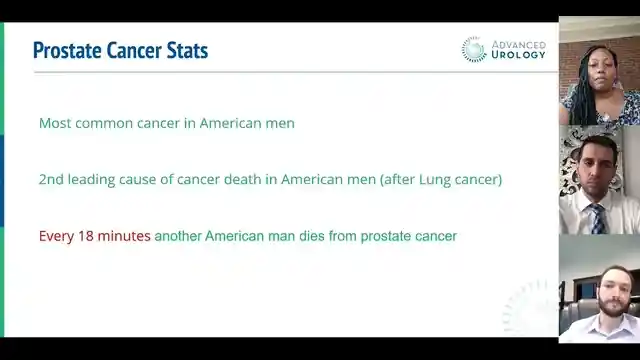 Watch: DocTalk: Primary Care Physician & Urologist Discuss Prostate Cancer
What the video covers. Titled "DocTalk: Primary Care Physician & Urologist Discuss Prostate Cancer." The public description states that early prostate cancer typically presents no symptoms, and it features Dr. Farber of this practice and Piedmont Internal Medicine's Dr. Cutler on their approach.
 Watch: What is Elevated PSA and how Advanced treats it
What the video covers. This official Advanced Urology video is titled "What is Elevated PSA and how Advanced treats it." It discusses elevated PSA and how Advanced Urology evaluates it.
Where do I read about a raised PSA versus a cancer diagnosis?
Our high PSA page stays on the work-up. Our prostate cancer page is for treatment planning after a diagnosis. This page is the overview that ties those conversations together.
Can the work-up start in Cumming?
Yes. Repeat labs, a clinic exam and planning can begin at either office. Biopsy and operations we perform are scheduled at Johns Creek.
What should I bring to a PSA visit?
Every PSA result you have, a medicine list, and notes about recent infection or other events that might have nudged the last blood draw.
Whenever a visit would help, the Johns Creek and Cumming teams are a phone call or a booked appointment away.